Neemias Queta Can't Stop Fouling
Data on Queta
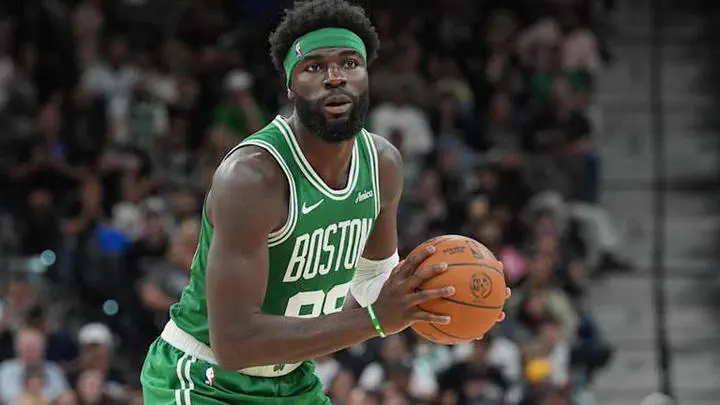
With 18 minutes left in the Celtics’ season, Jaylen Brown faced down the seven-foot, 280-pound Joel Embiid in the paint. Brown, who is six inches shorter than Embiid, would ordinarily have looked for help from a taller defender, but he was the tallest Celtic on the floor. He made a valiant effort to slow down Embiid, swiping at the ball and crouching to lower his center of gravity, but Embiid was tall enough that he could simply shoot over Brown.
Embiid used his size advantage to take over the second half en route to 34 points, ending a storybook season for the Celtics.
Why was Jaylen Brown the primary defender on the towering Embiid? The Celtics have struggled with center depth all year, but they have a clear defensive alpha in Neemias Queta, who has enjoyed a breakout season. Queta matches Embiid in stature and has successfully shut down opposing players in the paint. Within six feet of the basket, teams shoot just 54.2% when Queta is the primary defender. Compare that to backups Nikola Vucevic and Luka Garza, who allow these paint buckets at a 63.5% and 63.2% rate, respectively.
But Queta’s paint protection is tempered by his inability to stay on the floor. Earlier in the series, he acknowledged that his tendency to foul unnecessarily was impacting the team
“It starts with me,” Queta said in an interview. “Just gotta be better. Picking up early fouls… You’re always going to be a step behind. You’re only going to be a shell of yourself if you’re doing that consistently. So can’t be doing that. Team needs me out there and I’ll be better.”
In Game 7, that habit came back to bite; Queta committed an early offensive foul and then two loose ball fouls before the end of the first half. Fearing that he would foul out, the Celtics pulled Queta off the floor, leaving Brown to fend for himself against the much larger Embiid.
This costly substitution raised a harder question: just how much has Queta’s fouling actually hurt the Celtics this year? So I did some exploratory data analysis using play-by-play data to break down his foul activity.
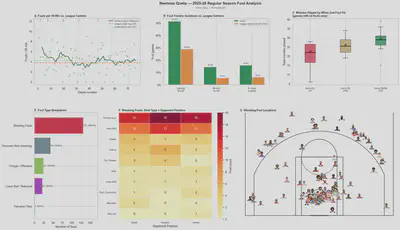
The analysis reveals a few important points.
First, Queta became more disciplined after a rough start to the year, but his progress in defending without fouling plateaued after 30 games. Even toward the end of the season, he still fouled at or above the league average among centers.
Second, Queta gets in foul trouble much more often than rival centers. Coaches closely track the number of fouls that players pick up during a game, and they often pull their best defenders if they get in foul trouble too early. This is both because coaches don’t want to risk playing in clutch situations without their A-team and because defenders tend to become less aggressive when they’re at risk of fouling out. Queta obviously has room to improve here; he picks up his second foul by halftime in more than half of games and is on the verge of fouling out in nearly a sixth of games. This is dangerous because, as figure C demonstrates, Queta plays meaningfully fewer minutes when he gets in foul trouble early. Premature substitutions can disrupt both Queta’s rhythm and Joe Mazzulla’s planned rotations.
Third, most of Queta’s shooting fouls are coming on layups around the rim, often from quick guards and wings who blow by him on the pick-and-roll. Queta has great blocking instincts but has mediocre lateral mobility, so he often gets confused with guards who employ hesis and change-of-direction to throw him off balance. He doesn’t foul much in the midrange, but he does get whistled on a fair number of three-pointers, which are especially costly.
It’s not just shooting that’s the issue though. 10% of his fouls come on the offensive end (almost all illegal screens) and another 10% from loose ball fouls. Reducing these calls might mean sacrificing some separation in the pick-and-roll and some offensive rebounding, but that’s a worthy price to pay to keep Queta on the floor.
“Obviously, [it] starts with me being better,” said Queta after game seven. “But [it’s] just the nature of the job as a center. You’re in a lot of different positions where you can get fouls, whether it’s ball screens, whether it’s box outs, whether it’s just one-on-one defense, being able to being able to protect the rim as well.”
Clearly, Queta recognizes the challenge ahead of him. To continue his momentum from this season and cement his place as the Celtics’ defensive anchor, Queta will have to fill that broad role without sending opponents to the line.
I’m grateful to Vladislav Shufinskiy for writing and open-sourcing the package that powered my data analysis.